


Description & specifications
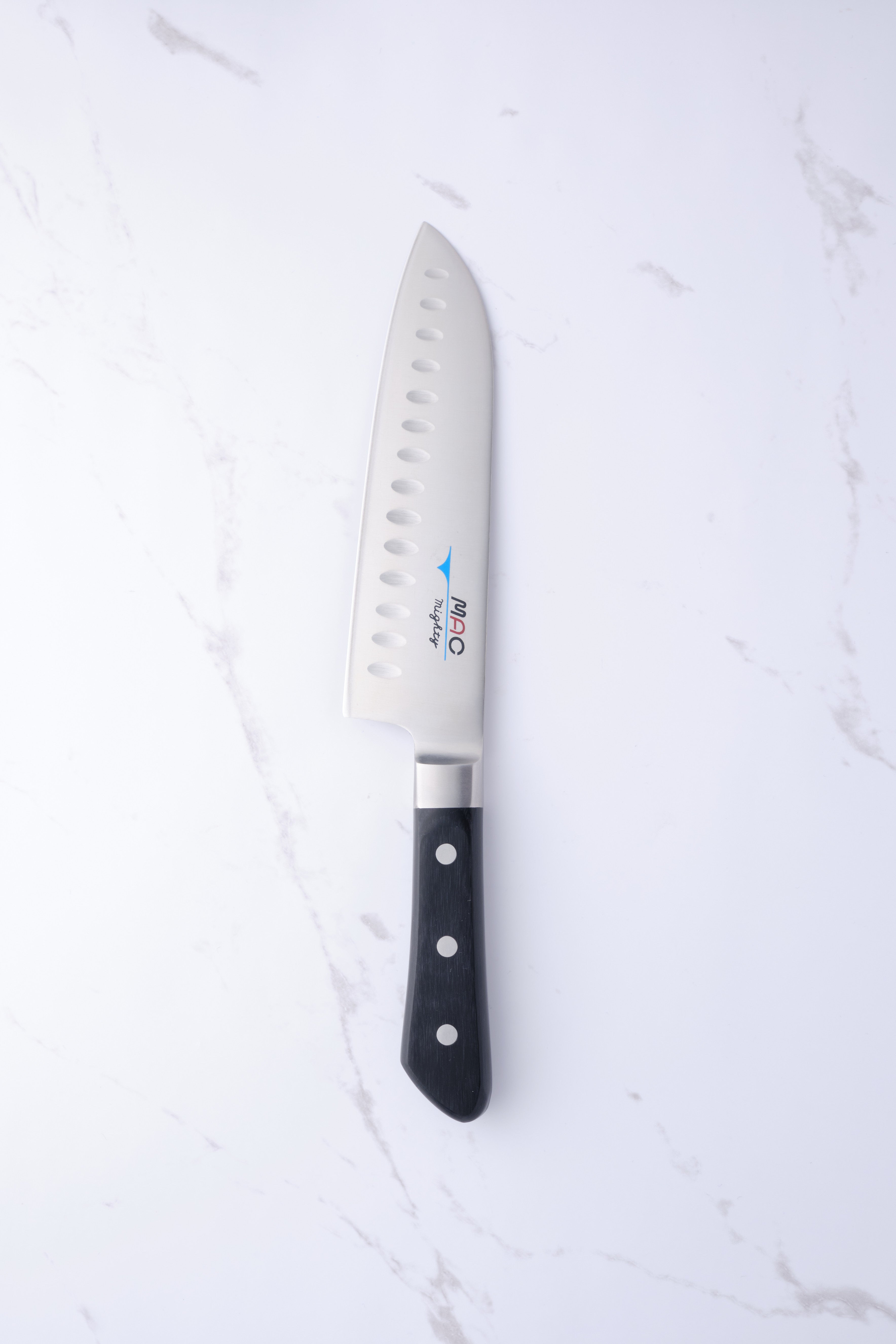
This Santoku from MAC's PRO series is one of our absolute favorites! The blade length of 17 cm appeals broadly to most tasks, especially working with vegetables, and gives the knife a good balance.
This knife is a santoku in classic Western style, but one of the areas where Japanese MAC differs from its European competitors is, for example, the thickness of the knife. The spine of this knife is, as Japanese santokus typically are – narrow. This results in a lighter knife than would otherwise be the case, but most importantly, it means the knife cuts rather than splits. This becomes very evident when cutting particularly hard vegetables and root crops – it is much easier with a narrow knife.
The santoku is characterized by its slightly shorter blade and gently curved tip. This makes the knife incredibly suitable as a vegetable knife.
The hallmark of the MAC Pro series is high-quality knives originally aimed at chefs and others who needed knives professionally. They are designed to be durable and to be used for hours every day.
For this knife, as for all other knives in our assortment, the usual basic rules apply. If you want to get the most out of your knife, stroke it on a ceramic sharpening steel – and do it calmly and carefully. If it needs sharpening, do it on a wet stone or have it done by us. Never use a dishwasher to clean the knife, and do not cut bone or frozen items – although MAC is a durable knife, care should always be taken. If you adhere to this, you will have a good knife for years.
| Type | Santoku |
| Length | 170 mm |
| Forging and steel | Single layer - stainless |
| Grind | Double bevel/standard |
| Handle type | Classic Western |
| Stainless | Yes |
| Hardness | Approx. 61 HRC |
| Handle material | Black Pakkawood |
| Saya |
No |
Foodgear always advises against cutting any form of bone or frozen goods. Knives should not be washed in a dishwasher, as this removes sharpness and promotes rust – even in stainless alloys!
Maintenance & use
Never cut into bones or frozen items as this may damage the egg. Always wash the knife by hand and dry it thoroughly immediately.
Please note that both the blade and handle can be seriously damaged and broken if the knife is washed in a dishwasher – this also applies to stainless steel and wooden handles.
We are proud suppliers to


